Yu-Jen Yu (Year 4 MinE) wins SAG Undergraduate Award
Yujen Yu (Year 4 MinE)
Yu-Jen Yu, a fourth-year Lassonde Mineral Engineering student, has won a SAG Conference Student Award. The SAG Conference Undergraduate Scholarship is awarded every four years from proceeds from the conference as well as donations from sponsors. To be eligible for an Undergraduate award, the student must be registered in the final two years of an Engineering or an Applied Science degree program that includes an educational component in the field of mineral processing.
Pierre Lassonde drops by to see Min students and deliver frank reflection on his life and career path
Mining legend and benefactor Pierre Lassonde urges students to “carpe diem” in personal address
Pierre Lassonde, O.C. urges student to “carpe diem” while giving an address Tuesday, November 18, 2025 at U of T. (Photo by Phill Snel / CivMin, University of Toronto)
At an in-person address on Tuesday, November 18, benefactor Pierre Lassonde, O.C. urges students to “carpe diem” when the opportunity arises. The personal visit to talk with and socialize with Lassonde Mineral Engineering students provided the chance for Lassonde Scholarship recipients to express their gratitude at the face-to-face event. Keen to share insights gained over a long career, he repeatedly mentions the benefits of having good people as support and to avail oneself of opportunities as they arise.
In his frank discussion with students, after prompting them with, “I urge you to carpe diem.” Lassonde then follows with, “Do you know what carpe diem means?” After a brief exchange with the gathered audience he says, “It means seize the day. Whatever you do, whether it’s a yes or no, act when an opportunity arises.”
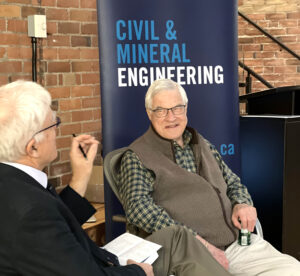
Pierre Lassonde (centre, light sweater) poses for a photo with students during his visit to the Department of Civil & Mineral Engineering (CivMin) on Tuesday, November 18, 2025. (Photo by Phill Snel / CivMin, University of Toronto)
Lassonde begins his heartfelt address to students with little fanfare, telling of his surprising success in business ventures, while also laying bare his vulnerabilities during the early stages of his career as an engineer. He candidly reveals how his sudden and incredible wealth changed him, crediting his late wife, Claudette MacKay-Lassonde, and business partner, Seymour Schulich, for keeping him grounded during this pivotal time.
Pierre Lassonde is surrounded by students after his talk on Tuesday, November 18, 2025. (Photo by Phill Snel / CivMin, University of Toronto)
The co-founder of Franco-Nevada traced his career from electrical engineering student to reshaping how mining is financed. He continuously challenged students to think beyond a Bay Street office role, probing them with questions to stimulate conversation. “How many people do you think have ever lived on Earth?” After a brief flurry of replies, he reveals the figure as 117 billion, encouraging the young attendees to broaden their horizons. Travel and see the world. Get an appreciation for more than is simply before you – expand your horizons and gain a greater perspective.
Applying somewhat of a crystal ball peering into the future, Lassonde offers mining career advice to the young audience, “If I were you, I would head to the Yukon,” he reveals while reflecting on a recent trip to the territory as part of exploring business opportunities. “Do you know the population of the Yukon? It’s about 50,000 people.” Further rationalizing how the economic benefit for mineral exploration could potentially be enormous for such a small population, along with opportunities to forge relations with Indigenous communities there.
Pierre Lassonde (centre) poses with a gift sweatshirt presented by Iyesha Rupasinha Arachchige (right), Min Club President and Prof. Sebastian Goodfellow. (Photo by Phill Snel / CivMin, University of Toronto)
Showing just how much mining matters, he shifts from the broad perspective of worldwide travel, to practical thinking from an industry overview. While probing students for their thoughts and insights, Lassonde queries, “What’s the most critical mineral?” Answering, “Copper. Without it there’s no communications, no power, no wiring. Yes, of course you need other materials for other purposes, but without copper the rest wouldn’t be possible,” outlining how it underpins everything from power grids to electronics.
After a lighthearted photo opportunity with a branded sweatshirt presented by Iyesha Rupasinha Arachchige (Year 4, MinE), Min Club President, the event wound up with students gathered around Lassonde. Those assembled pressed closer, eager to speak directly to the philanthropist, shake his hand in thanks and pose for photos. He left the smiling and satisfied students much as he arrived – simply. No entourage, save for a single companion, and carrying some gifts for his grandchildren to offer at a small family dinner in Toronto.
By Phill Snel
A philanthropist and talented businessman, Pierre Lassonde is recognized as one of Canada’s foremost experts in the area of mining and precious metals. His cumulative giving to the University of Toronto exceeds $10 million, the largest contribution to mineral/mining engineering education in Canadian university history. Both the Lassonde Institute of Mining and the Lassonde Mineral Engineering Program, as well as the Lassonde Mining Building bear his name.
In 2001, he was granted an honorary degree by the University of Toronto. Lassonde has received many other awards, including the Order of Canada, Mining Person of the Year and Developer of the Year as well as other honorary doctorates in Canada and the U.S. He was inducted into the Canadian Mining Hall of Fame in 2013.
Energy, EV, Mining research showcased during visit with PA Chris Scott
A visit by Parliamentary Assistant to Minister of Energy and Mines allows CivMin’s Professor Lesley Warren to highlight the Lassonde Mineral Engineering program, online learning with Mining Industry Management Program (MIMP), as well as industry partnerships in mineral and mining research.
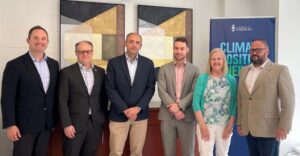
Left to right: Forrest Parlee (Deputy Chief of Government Relations, U of T), David Black (Senior Consultant – Government Affairs, Siemens), Professor Olivier Trescases, Spencer Page (Manager, Corporate Affairs, Vale Base Metals), Professor Lesley Warren, and PA Chris Scott.
On June 13, U of T welcomed MPP Chris Scott, Parliamentary Assistant to the Minister of Energy and Mines, for a lab tour and briefings on the university’s grid, electric vehicle (EV), and mining research – areas also affiliated with the Climate Positive Energy (CPE) Research Initiative.
Profile: Raymond Bhushan (Year 4 MinE), is seeking another leadership role as MPP in the coming provincial election
Raymond Bhushan (Year 4 MinE ) is the current President of Min Club, the discipline club for Lassonde Mineral Engineering students. Before commencing his final year of studies this year, he completed a PEY Co-op, relocating to Sudbury, Ont. for over a year last year. Additionally, Raymond is accomplished academically, having received the Okane Consultants Sustainable Mining Scholarship in his third year of studies. He recently talked with us about his experience in the LME program at U of T and of pursuing a role as MPP in provincial politics.
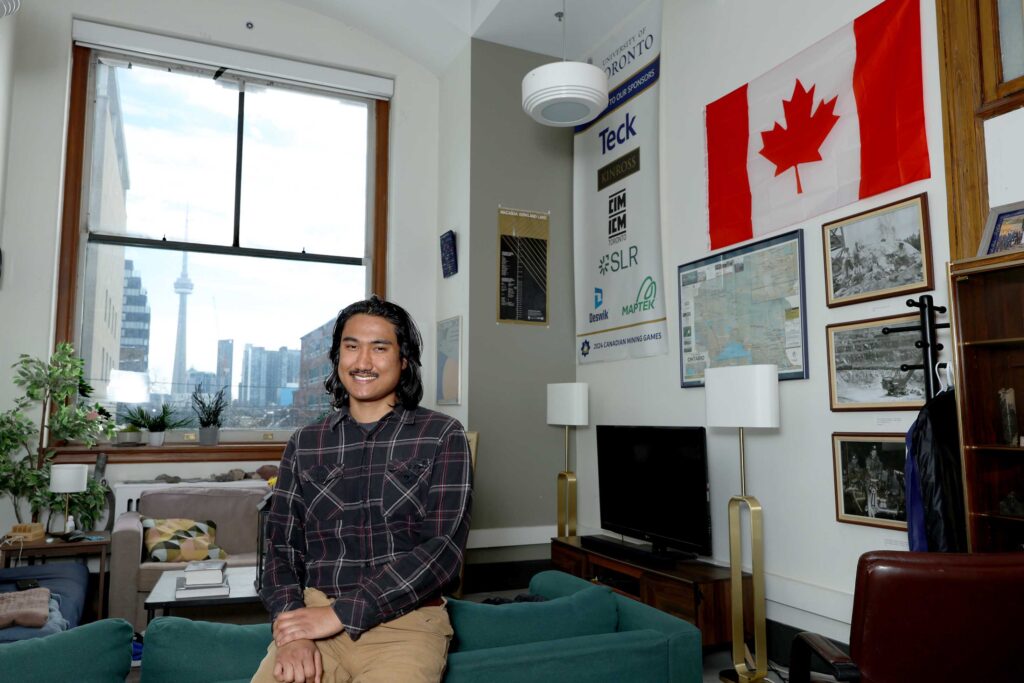
Raymond Bhushan in the Min Club Common Room. The fourth-year student is in the Lassonde Mineral Engineering undergraduate program in the Department of Civil & Mineral Engineering at the University of Toronto. (Photo by Phill Snel / CivMin, University of Toronto)
Raymond, please tell us about yourself as an introduction. I am currently in my fourth year in the Lassonde Mineral Engineering program at U of T. I am the President of Min Club, which is the association for all the undergrad students in mining engineering. And I am currently running for office in this provincial election for the position of MPP, member of Provincial Parliament, in Richmond Hill as a candidate for the Ontario NDP.
I take it you grew up in the area you’re running? Yes, I went to high school at Bayview Secondary School in Richmond Hill. And I grew up in the community and have a strong connection to it. That’s why I want to represent Richmond Hill.
What made you seek out your first leadership role, which is president of Min Club? I was always involved in Min Club. Even in first year I was a class rep and I think that just kind of came out of a desire to organize and help my fellow students. I had a great mentor, Alec Gilvesy (MinE 2T2+PEY) who was president a couple years ago, and he encouraged me to become more involved in Min Club, to help plan activities to help and represent the interests of students. Overall, I’d say my reason for getting involved in Min Club is because I wanted to create [a better] experience for my fellow students.
Do you have any similar Feelings towards running for MPP in this election? I think so. I think it’s a kind of commitment to, not my fellow students, but instead my fellow residents. A commitment to serving the public of Ontario.
I think we can all agree that not everything’s perfect. There are issues both in Richmond Hill and in Ontario that need to be resolved. Things like the housing crisis, rising unaffordability in terms of gas, groceries, and other living expenses. And I think, especially as students and young people, people like me at U of T are facing those issues – rent In Toronto is higher than ever. Or right across the province, in fact, the cost of living is higher than ever.
Climate change is making it harder to live in Ontario and affecting the environment in general. I think that’s part of the reason why I’m running, because a lot of these issues that are affecting Ontario are affecting me and my friends and my colleagues and my peers.
How do you feel about your area you’ve gone into academically as an engineer? Do you think that’s something that’s made you better, perhaps more aware, better able to articulate some of the problems affecting the public and students overall? Definitely. I think having a background in engineering definitely helps within the political sphere. I think politics shouldn’t be a space that’s dominated exclusively by lawyers and political science graduates. I think we, as engineers, need to become more involved in politics regardless of partisanship, regardless of whichever party you support. I think engineers are given the tools to identify problems and to seek solutions.
The entire engineering design process is about not just identifying what people say is a problem, but what is truly the problem that needs to be resolved. And what is the most effective strategy to resolve that. Now that could be an engineering design in the engineering sphere, or that could be a policy change in the political sphere. I think engineering also gives us the ability to engage in technical discussion, engage in research and engage in these kinds of communications between experts and non-experts that we also need in the political sphere.
What attracted you to apply to and attend U of T for Engineering? I went to high school kind of in the GTA. So U of T was always the big place we would go. Whenever we’ve had conferences or tournaments or whatever for all the clubs I was in during high school. It was like a great experience for me as a kid, who was growing up in the suburbs, never being able to see the big city except for these rare opportunities.
So U of T kind of captured my heart that way – I always really wanted to go to U of T because it was right in the big city. There was so much going on and it has a reputation of having incredibly talented faculty members who are top of their fields, incredibly, incredibly talented students and peers who will become your coworkers in the future. And, overall, I think U of T is just such a great place … and I am incredibly fulfilled coming here.
You’ve had more than just academic experience. You spent more than a year in the real-world workforce on your PEY Co-op [Professional Experience Year Co-op] placement. Can you tell us a bit about this 16-month experience? So, I spent 16 months at my co-op in Sudbury, working at the Copper Cliff Mine, doing a general mining engineering co-op term. I really enjoyed the experience. It gave me hands-on experience in the mining industry while getting to rotate around and see a lot of different sides of mining – right from ventilation to ground control to project management.
It also helped me meet so many amazing people. One thing, kind of unrelated to work, but more related to living in Sudbury is the fact it exposed me to different types of people. People who live in Richmond Hill and Toronto might have different values, and different ways of living, than someone who lives in northern Ontario.
And you don’t really think about how people live differently, how people act differently, the different values people have until you experience that firsthand. I think the experience not only benefited me as a person but also tying it back to politics and running in elections. It helps me empathize better with people from all sorts of different political stripes, all sorts of different backgrounds to understand them better because it’s very easy in today’s day and age, where everyone’s polarized, to dismiss people out of hand. In reality, everyone has their own experiences. Everyone has their own backgrounds, and I think there’s value in dialogue and communication.
Do you have any other clubs, groups or interests you’ve followed here at U of T while you’ve been a student? Not unexpectedly, I’m part of the U of T NDP. It’s the campus club for the NDP representing the interests of students, to promote the party on campus and to get students involved in politics.
I think getting young people involved in politics is so important. Again, regardless of your political affiliation, I think if you’re a young person it’s incredibly important because there is a trend among political leaders of ignoring the needs of young people. They might see young people as unengaged and as an unreliable voting bloc; they see them as not necessary or not important in making governance decisions.
I think we, as young people, if we’re rightfully upset at our political leaders, we need to have that engagement. And whether that engagement is through a political party or whether it’s through a community organization, or whether it’s through a campus club, any involvement is important. Because that lack of political engagement, that lack of community engagement is harming our political environment and harming our social relations. I think civic engagement, at this point in time, is just so critical.
I was also part of another club too – the U of T Academic trivia club. Basically, it’s like quiz bowl, kind of like Reach For The Top, in the sense that they ask you trivia questions and you answer them. I joined that club in my first year and it helped me meet so many wonderful people – I made a lot of friends there too.
You’re in your fourth year, finishing up your undergraduate academic journey, and soon you’ll get your Iron Ring. If you could talk to your first-year self, just before starting, what sort of advice might you impart? I think the most important piece of advice that I was ever told, and that I’ve been following ever since, was that you should always be saying yes to opportunities, and you should always seek out new opportunities. If someone you know asks you, “Hey, do you want to go do this. Hey, do you want to try this?” Just say yes. What’s what’s the worst that could happen, right?
I always say that when you’re lying on your deathbed, reflecting on your life, what are your biggest regrets going to be? They’re not going to be the things that you did; they’re always going to be the things that you never accomplished.
A couple weeks ago, I was giving a talk for our first-year students in Min and that was one of the pieces of advice that I was trying to hammer down: Say yes to new opportunities, try different things regardless of whether that’s in your career path, your academics or in your social life. Just try something new and say yes when the opportunity is presented.
If your friends or classmates ask you to watch a hockey game, even if you don’t like hockey, say yes. Because, you know, maybe you’ll learn you like it, maybe you learn you don’t like it, but at the end of the day, it’s, you know, time that you spend with your friends. If you get an offer for your co-op position and it’s somewhere you think you don’t like, just say yes. Just try it out. At the end of the day, it’s only four months or 12 months or 16 months, and maybe you’ll learn something new about yourself and like it.
On campus has there been anywhere that you found as your go-to spot or a secret spot for studying or socializing? Well, not really a secret spot as it’s quite well known, but the Min Club Common Room. It’s, in my opinion, the best common room out of all the Engineering disciplines. We’ve got a beautiful view of the CN Tower and downtown buildings, a beautiful, big window that lets natural light in, and there’s always somebody there – from first year to fourth year. It’s always like people. To talk to people, to hang out with. It’s a good place to study. It’s a great place to socialize, and it’s such an integral part of the Min Club community.
And I also want to give a shout out to my current VP Finance, Rain Ferrer (Year 4 MinE), who has been doing a great job at improving the amenities in the common room, doing little things such as quality-of-life improvements – everything from better light bulbs to making it more overall more comfortable.
Are there any memorable courses or professors who have, stuck out to you during your nearly four years at U of T? I think the Min program is just so blessed to have so many incredible lecturers and instructors and professors. And, honestly, all the Min courses I’ve taken have been quite good – I’ve enjoyed all of them.
I do want to give a special shoutout to Ryan Van Engen and Michel Julien, who taught MIN330 Mining Environmental Management, because that kind of helped me realize I do enjoy this aspect of mining in terms of environmental management, water management, tailings management. So, thanks to them, and thanks to the course, it kind of opened my eyes and exposed me to that sector. Since then, I’ve gone on to do more things in that area.
A couple of years ago I won the Okane Consultants Sustainable Mining Scholarship, again using the knowledge and interest I gained from that course. Then, at the Canadian Mining Games that I’m also part of, I took part in the sustainable development events because I find that super interesting, both academically and in practice.
Also, Alan Lambden, who teaches the Reserves and Resources course, I think he did a good job at teaching, but I also hung out with him outside of class too. Just getting a coffee with him and he’s a very supportive instructor. He has great experience and great wisdom as well.
And then, lastly, I want to give a shoutout to Professor Kamran Esmaeili. Not just for all the courses he teaches, but also because he’s such a big presence in the CivMin community. He’s been a huge proponent of developing our Min program further. He pushed for the creation of a Youth CIM student wing at U of T. So he really facilitated that and overall, he’s been a huge support for Min students – a pillar of support.
Do you have somewhere else around campus you like to go to socially or a special place for food near to campus?
I really like the pink food truck. I always get the spicy chicken burger combo there. I probably eat there more than I should, but the food is really good and it’s very convenient, very fast. He’s also very polite, so probably my favourite spot on campus to eat.
Do you have some sort of unusual talent or skill we wouldn’t otherwise know about, but care to mention here? Normally, my fun fact is that I ran for office but, since you already know that, it’s not really a new fun fact. I did run in the last provincial election in 2022, which was about two-and-a-half years ago.
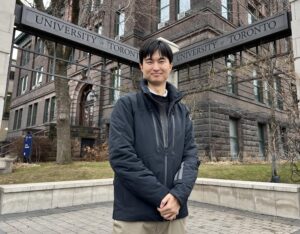
Professor Minghan Xu stands in front of the U of T gates by the Lassonde Mining Building. (Photo by Phill Snel)
Professor Minghan Xu joins the Department of Civil & Mineral Engineering as an Assistant Professor as of January 1, 2025.
CivMin spoke with Professor Xu to learn more about his research direction, passion for teaching, and what attracted him to Toronto. He has relocated from Montreal to join our department.
“We wholeheartedly welcome our newest faculty member to the Department,” says CivMin Chair Marianne Hatzopoulou offering her greetings. “Students will benefit from the exciting new elements Professor Xu brings to the Department in teaching and research. Join us in offering our newest professor a warm welcome to CivMin.”
Treat for LME students: Fireside chat with alumnus Ross Lawrence
Exclusive event for Lassonde Mineral Engineering students: Fireside chat with Ross Lawrence (GeoE 5T6), recently inducted into the Canadian Mining Hall of Fame
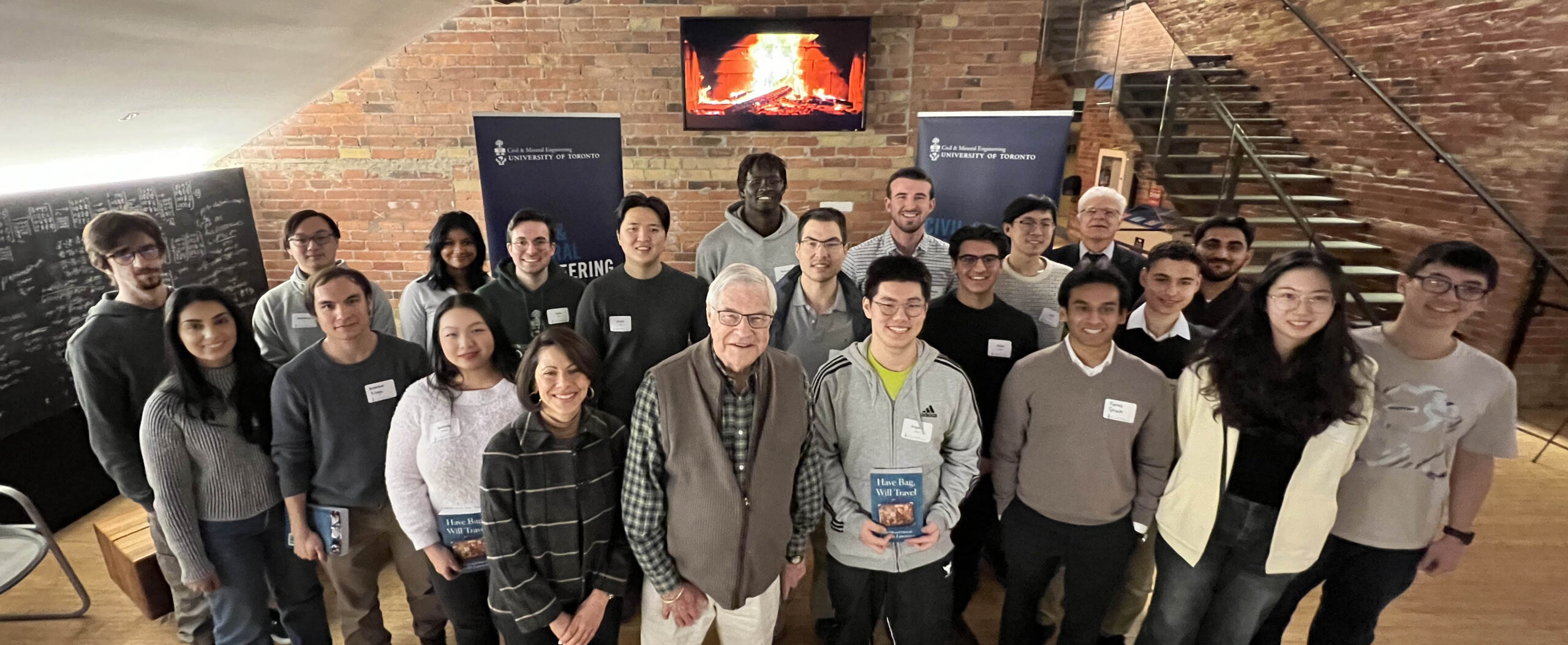
A photo of the attendees from the Ross Lawrence (GeoE 5T6) Fireside Chat on Wednesday, January 17, 2024 on the fourth floor of the Lassonde Mining Building at the University of Toronto. The event with special alumnus guest speaker, a recent inductee into the Canadian Mining Hall of Fame (CMHF), was hosted by the Department of Civil & Mineral Engineering for largely undergraduate Lassonde Mineral Engineering Students. (Photo by Phill Snel, CivMin)
Prof. John Harrison (L) gestures to Ross Lawrence during the Fireside Chat event on Wednesday, January 17, 2024. (Photo by Phill Snel, CivMin)
He graciously agreed to share his career and life experiences with us during an intimate “fireside chat” on Wednesday, January 17. This exclusive event for our Min students, supported by Engineering Advancement, included a light fare reception following the talk.
After a welcome from CivMin Chair Professor Marianne Hatzopoulou, along with insightful perspective on the impact of mining on Indigenous communities at home and abroad, the talk was moderated by Professor John Harrison.
Revealing mysteries within: CivMin’s new X-ray and CT device peers inside solid objects
A new device in CivMin’s repertoire of high-tech machines allows researchers to peer inside solid objects. Using X-ray and computed tomography (CT) scans, the new system enables detailed 3D imaging in a non-destructive manner, literally allowing the unseen to become seen, and displayed upon a screen, with incredible detail.
New Mining Industry Management Program (MIMP) at the University of Toronto
Recognizing a gap in available professional development, CivMin Professor Kamran Esmaeili undertook the task of creating a program of new online courses for mining industry professionals
With a fourth-place finish in 2021 Canadian Mining Games virtual competition, the U of T team was a mere 20 points behind first place. An incredible accomplishment for the team made up of predominently first-time participants.
Lassonde Mineral Engineering Students take gold – 4 oz of gold
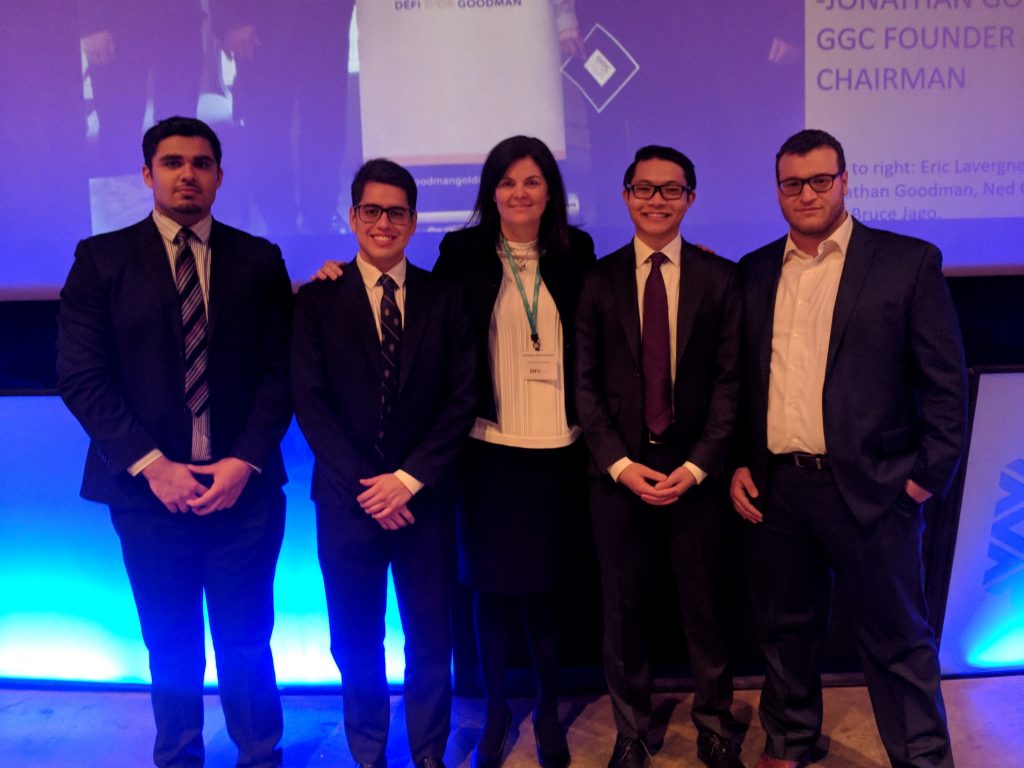
Winning Lassonde Mineral Engineering Team (Zawwar Ahmed (MinE Year 3), Dalton Veintimilla (MinE Year 4), Ice Peerawattuk (MinE Year 4) and Jihad Raya (MinE PEY)) with Candace MacGibbon, CEO of INV Metals (at centre).
This weekend, Zawwar Ahmed (MinE Year 3), Ice Peerawattuk (MinE Year 4), Jihad Raya (MinE PEY) and Dalton Veintimilla (MinE Year 4) successfully defended their first place title in the Goodman Gold Challenge (GGC) in Sudbury.
The GGC is a competition at Laurentian University that invites undergraduate students to assess three gold companies as investment opportunities. In teams of four, students recommend one of the three companies to a top-tier client.
The Lassonde Mineral Engineering team won the cash equivalent of four ounces of gold for their outstanding use of their academic and practical skills at the GGC.
Congratulations from the Department of Civil & Mineral Engineering. Keep up the good work!
That’s a wrap of #GGC2019! @MiningUofT is the team that offered the best recommendation as to which company they should invest in and wins the cash equivalent of 4 ounces of gold! Big THX to everyone involved, sponsors, participants, and guests! See you in #GGC2020! pic.twitter.com/BeAAKqxQ1D